


“A quantum computer is not a faster laptop”
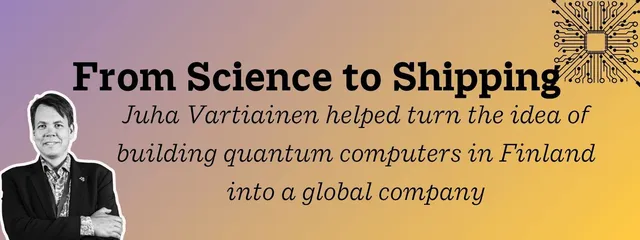
In its earliest days, IQM was “basically a few scientists, a lot of ambition, and not nearly enough structure or sleep”, recalls co-founder Juha Vartiainen. The team saw a clear opportunity: Europe had excellent quantum science, yet very few companies were building quantum computers. “That was the moment we thought: why shouldn’t one of the global winners come from Finland?”
Quantum computing can seem almost impossible to understand. Vartiainen begins with what it is not: “A quantum computer is not a faster laptop.” It is an accelerator for specific calculations, similar to how graphics processors became essential for AI. Using the rules of quantum physics, it could tackle problems that are extremely difficult for conventional computers. This may help develop new materials, medicines and energy technologies, or solve complex logistics problems. Nobody, however, will need one to read their email.
Start shipping
Turning this promise into a business meant doing almost everything at once: developing the technology, selling internationally, building delivery capacity, hiring specialists, raising capital and finding buyers for a product category that barely existed. “Great science is necessary, but it is not enough,” Vartiainen says. “At some point you have to stop admiring the technology and start shipping products.” The biggest change was moving from scientist to salesman.

Optimism is useful, but product quality gets the final vote
His earlier work in medical diagnostics and space technology taught him that advanced technology takes time and must work outside the laboratory. In both fields, an “almost working” product is not acceptable. Quantum computing reinforced the lesson: “Optimism is useful, but product quality gets the final vote.”
Today, Vartiainen works where technology, industrial strategy and geopolitics meet. “Computing power is power.” Quantum computers may become critical infrastructure, like semiconductors, AI and supercomputers. Europe should not discover too late that another strategic technology is controlled elsewhere or unavailable when needed.
A greater willingness to accept risk
Europe’s challenge is not a lack of science. “Europe is very good at funding research and sometimes less good at funding the scaling.” Vartiainen calls for larger growth investments, faster decisions, stronger European customers and a greater willingness to accept risk. His measure of success goes beyond academic excellence: “We should become as proud of building a €100-million technology company as we are of publishing an excellent scientific paper.”
Competition and cooperation are not opposites
International cooperation remains essential, even as countries compete for leadership. Common standards for interfaces, terminology and safety can enlarge the market without weakening competition. Vartiainen points to smartphones as an example: shared standards made competition bigger, not smaller. “Competition and cooperation are not opposites.”
Through BOLD, he hopes to meet people from other industries who view technology, leadership and global change from unfamiliar angles. “The most interesting ideas often appear when different worlds collide.” His own journey reflects that conviction: “I am BOLD because I stay curious, follow the vision even when the path is uncertain, take controlled risks, and helped turn the idea of building quantum computers in Finland into a global company.”