
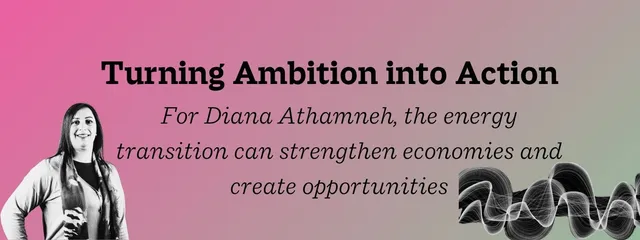


Energy, digital transformation and public policy
Diana Athamneh’s interest in energy began in an unexpected place: a water-pumping station. During a university course, the civil engineering student was struck by the size of the pumps and the energy needed simply to move water. “That experience made me see infrastructure differently,” she recalls. “Water, energy and development were not separate issues; they were deeply connected.” That moment gradually shaped her career.

The objective is not simply to digitalise more. It is to use digitalisation intelligently
Today, Athamneh works where energy, digital transformation and public policy meet. Digital tools can help manage resources, integrate renewables and improve public services. But digitalisation itself must become greener. “Digital technologies are not impact-free,” she warns. Data centres use energy and water, devices require raw materials and digital growth creates electronic waste. “The objective is not simply to digitalise more. It is to use digitalisation intelligently.”
Renewable generation alone will not be enough
For Jordan, this offers more than environmental benefits. “The energy transition is not only a climate priority; it is also an economic and strategic opportunity.” Local renewable resources could reduce exposure to imported fuels and changing prices. The transition could also create opportunities in storage, electric mobility, green hydrogen and digital energy services.
Renewable generation alone will not be enough. Athamneh points to modern grids, storage and closer links between electricity, water, transport and industry. The transition must also create opportunities for young people, communities and businesses while protecting affordability and ensuring “that no one is left behind”.
Water, infrastructure and long-term demandAcross the MENA region, countries share rising energy demand, water scarcity and financing constraints. Yet their conditions differ. “There cannot be a single regional model,” Athamneh says. National solutions should be combined with regional cooperation.
Water, infrastructure and long-term demand
She applies the same realism to green hydrogen. It could support industrial processes and sectors that are difficult to electrify, such as shipping and aviation. But it is not “a universal solution”. Direct electrification and energy efficiency are often more affordable. Water, infrastructure and long-term demand must also be considered. “Producing hydrogen is only one part of the equation; a competitive and credible value chain must be built around it.”
Good decisions require reliable data. “Without a clear baseline, we cannot identify priorities, direct investment effectively or determine whether a policy is delivering its intended results.” Clear reporting strengthens accountability and helps move societies “from assumptions to evidence”.
Sustainability cannot be delivered by one institution alone
This path from ambition to action is at the heart of Athamneh’s work. Successful policies need clear responsibilities, financing, technical capacity and measurable indicators. They must also involve the people who will carry them out or be affected by them. “Sustainability cannot be delivered by one institution alone.” It requires trust, coordination and shared commitment.
Athamneh hopes to foster the same cooperation through BOLD by connecting governments, entrepreneurs, researchers and industry. “I am BOLD because I choose to enter emerging fields, connect sectors that are often treated separately, and turn ambitious ideas into practical action.”